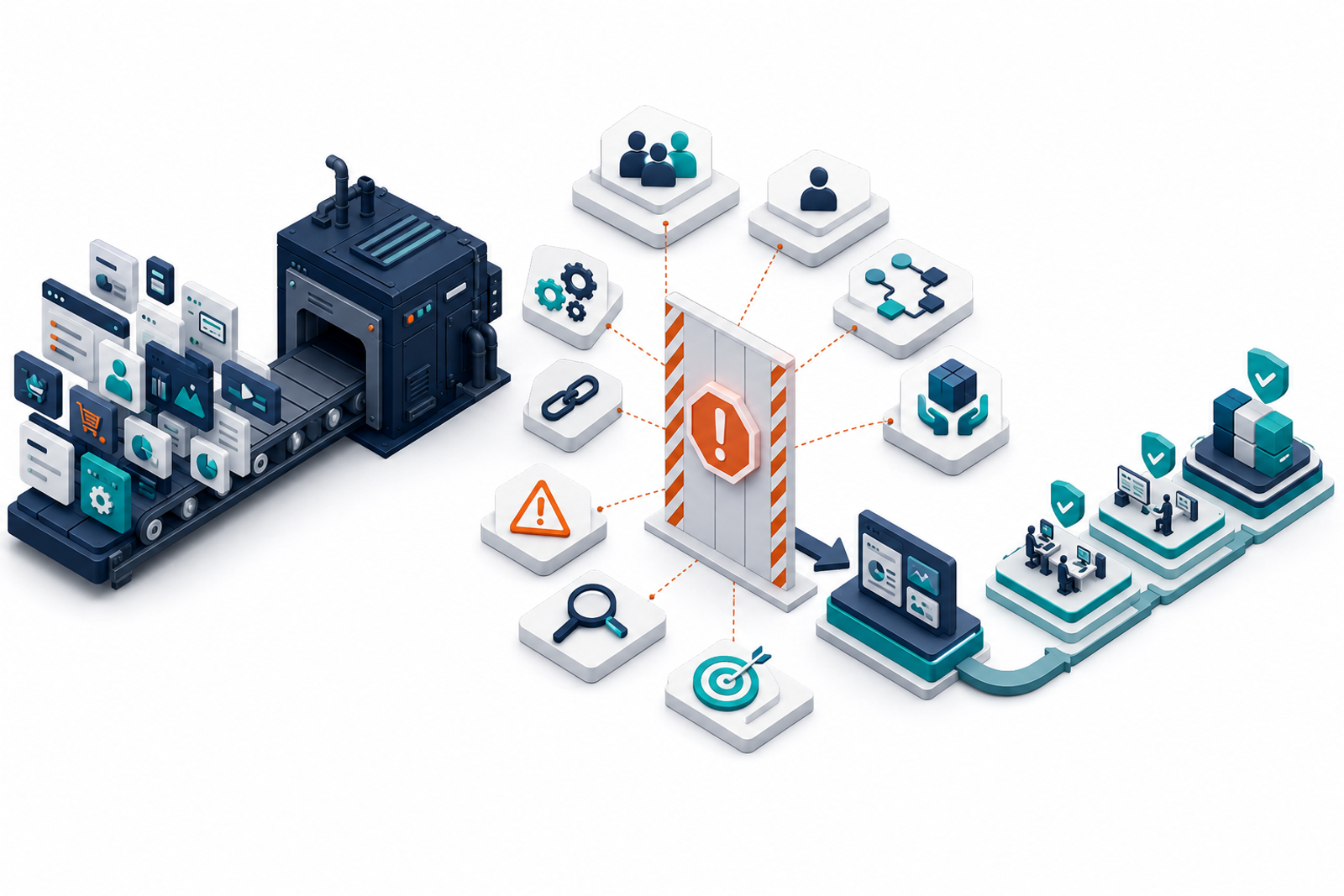
A custom software project can have capable engineers, modern technology, and a reasonable schedule while still being structurally wrong before the first production line is written.
The failure begins when the project assumes it understands the user, workflow, ownership, constraints, and first learning goal better than it actually does. Coding then makes those assumptions expensive.
This is especially common when a domain expert or founder sees a real problem and moves directly from the idea to a feature list. The opportunity may be valid. The proposed product shape is still only a hypothesis.
The specification can be detailed and still describe the wrong product
A long requirements document often creates confidence because many decisions appear settled. But detail is not evidence. Teams can specify screens, roles, notifications, reports, and integrations without proving who will use the product, which behaviour must change, or which part of the workflow creates enough value to justify adoption.
The strongest early work does not ask how to implement every requested feature. It asks which assumptions would make the whole project invalid if they are wrong.
1. The primary user and buyer are not the same person
A product may be used by frontline staff, approved by a manager, purchased by an owner, and constrained by an administrator or compliance role. Designing for one perspective while another controls adoption creates a product that can be useful and unsellable at the same time.
The project should identify who experiences the problem, who receives the value, who carries implementation cost, who can block adoption, and who owns the final decision.
2. The workflow is described as it should work, not as it does work
Real operations contain interruptions, incomplete information, repeated requests, workarounds, late changes, manual judgment, and recovery. A clean happy-path diagram can hide the behaviour that will dominate support and trust after launch.
Before designing the product, observe or reconstruct actual cases. Identify where state changes, where ownership transfers, why exceptions occur, and how people recover today.
3. Nobody owns the product decision after development starts
Engineers can expose tradeoffs and propose solutions, but they cannot resolve conflicting business priorities without an accountable product owner. When nobody can decide which behaviour is correct, the implementation accumulates options, configuration, and rework.
The project needs one role with authority to accept scope, resolve ambiguity, protect the primary user outcome, and say no to features that do not serve the current learning goal.
4. Scope is organized around features instead of uncertainty
A feature list encourages breadth. A learning plan encourages focus. The first product step should test the riskiest assumptions with the smallest credible artifact.
That artifact may be a workflow prototype, a technical spike, a concierge process, an integration proof, an architecture phase, or a narrow MVP. The correct choice depends on whether the team needs to learn about desirability, usability, feasibility, reliability, or willingness to adopt.
5. Existing system and data constraints are discovered too late
Custom products rarely begin in an empty environment. They must coexist with identity systems, operational records, vendor APIs, spreadsheets, reporting obligations, security policies, and legacy workflows.
If the project assumes clean APIs, consistent identifiers, exportable data, or unlimited integration access, implementation can become a discovery exercise after estimates and expectations are already fixed.
6. Success is described as delivery rather than changed behaviour
Shipping the planned features is an output. It does not show that the product reduced a meaningful burden, improved a decision, made a workflow more dependable, or created enough value to change behaviour.
Define evidence for the first phase before building it:
- Which user can complete which important task?
- What current workaround or delay should change?
- Which assumption will be confirmed or rejected?
- What operational or product signal will be observed?
- What result justifies the next investment?
- What result means the direction should stop or change?
7. The project begins with a commitment that is too difficult to reverse
A full platform build combines product, workflow, technical, and operating assumptions into one large bet. When evidence is limited, the first commitment should preserve the ability to change direction.
Stable identifiers, explicit boundaries, narrow integrations, replaceable components, and staged data migration can make early progress useful without pretending the final product is already understood.
A safer pre-coding sequence
- Name the primary user, buyer, problem, and desired behaviour change.
- Map the real workflow, including exceptions and current recovery paths.
- List the assumptions that could invalidate the opportunity or approach.
- Identify existing data, integration, permission, and operating constraints.
- Choose the smallest artifact that can test the most important uncertainty.
- Define evidence, acceptance criteria, and a stop-or-change condition.
- Assign product ownership and decision rights.
- Only then scope the implementation needed for the next learning stage.
This sequence does not remove delivery risk. It prevents delivery from being used as the first method of discovering what the product should have been.
Coding should follow a decision, not create one accidentally
Software becomes expensive when implementation is asked to resolve unanswered business and product questions. Every database table, workflow state, and integration then turns an assumption into structure.
The best pre-coding work makes those assumptions visible, tests the most dangerous ones, and chooses a first product step proportional to the evidence available.
If you have a serious SaaS or custom platform opportunity but need to determine the right first product step, explore SaaS / MVP before committing to a full build.