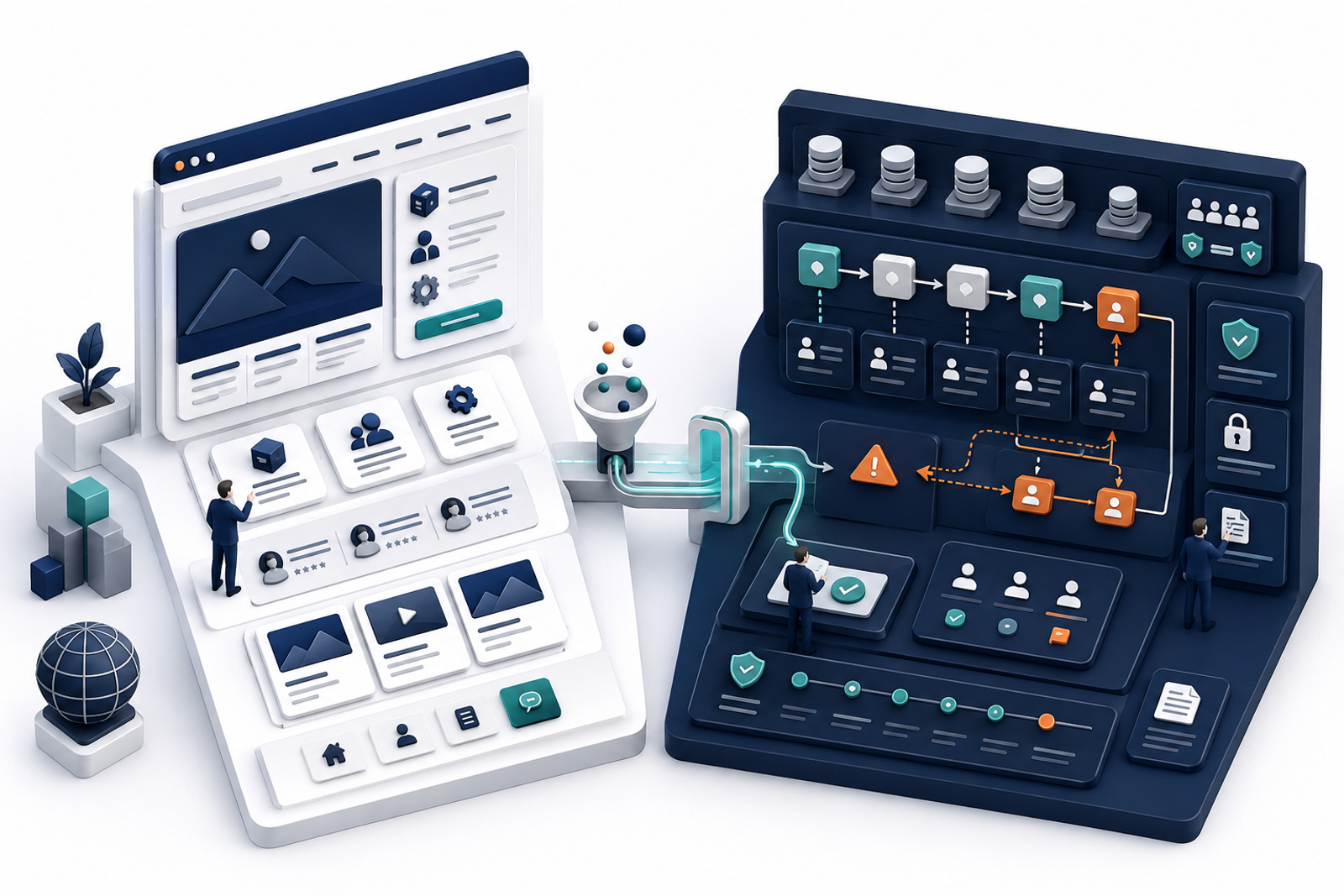
A website foundation and a business system can both organize information, guide actions, and support growth. They solve different categories of truth.
The website explains the business to an external audience and gives qualified visitors a dependable next step. A business system coordinates internal or client-facing operations after work enters the organization.
Confusing those responsibilities creates two common mistakes: expecting a website project to include an operational platform, or building internal software before the business has clarified its public message, proof, and inquiry path.
A website foundation owns public truth
A source-of-truth website organizes what the business can say publicly and how a serious visitor should move through that information.
Its responsibilities normally include:
- positioning, audience, and problem framing;
- service or offer definitions and boundaries;
- proof with honest ownership and permission labels;
- articles and other public guidance;
- navigation and information architecture;
- contact, booking, qualification, or intake paths;
- search, sharing, accessibility, and technical website foundations;
- a maintainable publishing and update model.
The website may collect a form, send a notification, accept a booking, or connect to an established service. Those functions support the client journey. They do not automatically make the website the operational system of record.
A business system owns operational truth
A business system coordinates work that has state, ownership, permissions, handoffs, exceptions, or audit requirements.
Its responsibilities may include:
- customer, case, project, order, or workflow records;
- authoritative operational states and transitions;
- role-based access and approval boundaries;
- assignment, queues, deadlines, and escalation;
- integration with established systems;
- audit history, reconciliation, and recovery;
- operational reporting and exception visibility;
- guardrailed automation or AI-assisted workflow steps.
This system may have a portal or user interface that resembles a website. The difference is not visual. It is the responsibility carried by the data and workflow behind the interface.
The simplest boundary test
Ask what happens if the information is wrong or the action fails.
If the consequence is that a visitor misunderstands the service, cannot evaluate proof, or chooses the wrong inquiry path, the problem belongs primarily to the website foundation.
If the consequence is that work is assigned incorrectly, an approval is bypassed, a record becomes inconsistent, a deadline is missed, or the organization cannot reconstruct what happened, the problem belongs primarily to a business system.
Common needs that look similar but are not
Website intake versus workflow intake
A website form can collect enough information to qualify and route an inquiry. A workflow intake system may need saved progress, identity, document handling, validation, assignment, permissions, status, and follow-up across several operational stages.
Public content versus internal knowledge
Website articles explain useful ideas to a public audience. Internal knowledge may include procedures, sensitive context, decision history, templates, and role-specific instructions that require different ownership and access.
A proof page versus operational reporting
A proof page presents approved evidence and context. Operational reporting calculates current performance or exceptions from controlled records. Publishing a number and producing that number reliably are separate responsibilities.
A booking link versus scheduling operations
A booking integration can offer available times. Scheduling operations may require capacity rules, resource coordination, approvals, dependencies, rescheduling, reminders, and exception recovery.
When the website should come first
Start with the website foundation when:
- the offer, audience, proof, or next action is unclear;
- public information is scattered across channels;
- the business needs a credible maintained reference before promotion;
- inquiry quality is limited by weak explanation or routing;
- the operational need is still hypothetical or too vague to scope.
This creates a stable public layer and often clarifies which later workflow requests are real. It does not promise that portals, dashboards, payments, automation, or custom applications are included.
When the business system should come first
Start with an operational assessment or technical phase when:
- critical work already depends on fragile manual coordination;
- ownership and status are unclear across active cases or projects;
- data is duplicated or unreliable across systems;
- permissions, approvals, or audit history are material;
- integration failure or recovery is affecting operations;
- the public website is adequate but delivery behind it is under pressure.
The first step should investigate the workflow and source-of-truth boundaries before selecting or building software.
How the two layers can connect safely
A mature client journey may eventually connect public discovery to qualification, intake, scheduling, payment, portal access, delivery, and reporting. That does not require one system to own everything.
The website can remain the public source of truth while passing a qualified request into an operational system. Each layer should have a clear authority boundary, minimal data exchange, explicit consent and permissions, observable integration behaviour, and a recovery path when the handoff fails.
Choose the layer under the most pressure
The right first project depends on which truth is currently unreliable.
If people cannot understand the business, its evidence, and the next step, strengthen the website foundation. If the organization cannot control work after the inquiry arrives, investigate the business system. If both are weak, sequence them as separate phases with a clear boundary between public communication and operational state.
If you are unsure whether the immediate problem belongs to Website OS, Business Systems, SaaS / MVP, or Technical Backend, find your starting point before combining several kinds of work into one project.