
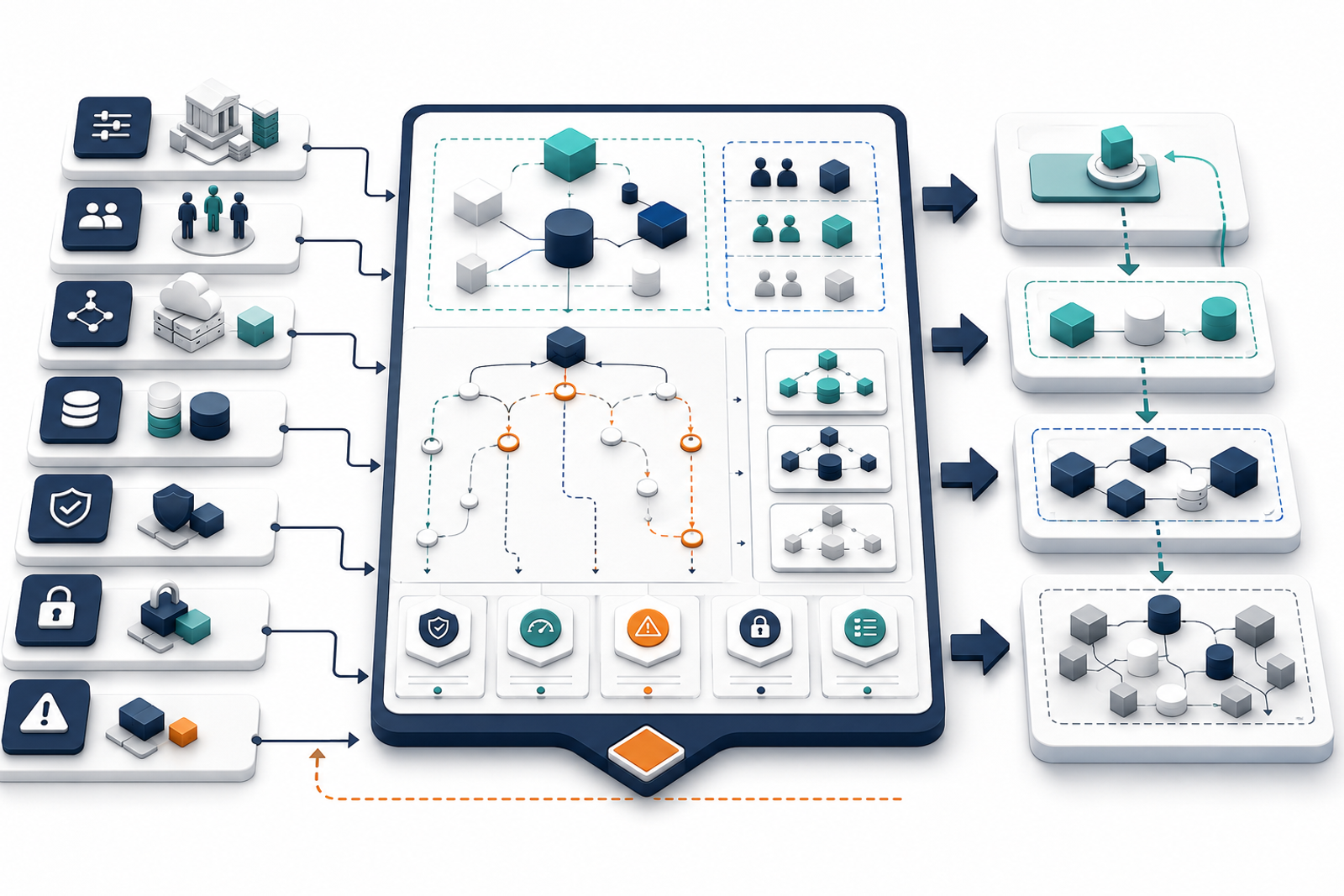
An Architecture Sprint should make implementation safer to begin. If it only produces diagrams, terminology, and a list of preferred technologies, the difficult decisions are still waiting for the delivery team.
The purpose is not to predict the whole system perfectly. It is to resolve the highest-cost uncertainty before code, contracts, and operational dependencies make direction expensive to change.
Architecture work should end with decisions
A sprint is useful when the team enters with material ambiguity: several systems must interact, a domain boundary is unclear, data ownership is disputed, reliability requirements affect design, or the first implementation sequence could lock the product into the wrong structure.
The output should explain what the team decided, why it decided it, what evidence supports the decision, which alternatives were rejected, and what remains intentionally unresolved.
1. What problem and operating context are being designed for?
Architecture begins with business behaviour. The sprint should identify the primary actors, critical workflows, expected volume, sensitive information, external dependencies, regulatory or contractual constraints, and the consequences of failure.
A system serving an internal low-volume workflow has different needs from a multi-tenant product or a payment-sensitive platform. Without that context, “scalable” and “secure” remain vague design preferences.
2. Where are the domain and ownership boundaries?
The sprint should define which concepts belong together, which team or service owns each important record, and where a change becomes an event or contract between boundaries.
This includes questions such as:
- Which system is authoritative for each important entity?
- Which rules must remain consistent in one transaction?
- Which capabilities may evolve independently?
- Where can eventual consistency be tolerated?
- Which boundary would be difficult to reverse after data accumulates?
Clear boundaries matter even in a monolith. They reduce accidental coupling now and preserve options later without introducing distributed complexity prematurely.
3. Which quality attributes materially shape the design?
Not every system needs the maximum level of availability, throughput, isolation, auditability, or configurability. The sprint should identify the small number of qualities that genuinely constrain the solution.
For each one, define a concrete scenario. How long can a dependency be unavailable? Which actions must never be processed twice? What data loss is acceptable? Which tenant boundaries must be enforced? How quickly must an operator diagnose and recover a failed workflow?
4. How will data move and remain trustworthy?
The architecture should show more than databases and arrows. It should describe identity, validation, ownership, state transitions, event delivery, retries, idempotency, reconciliation, retention, and audit history where they matter.
External integrations deserve explicit failure paths. A successful local write followed by a failed remote call is not an edge case. It is a normal distributed-systems condition that the design must make visible and recoverable.
5. What are the security and permission boundaries?
The sprint should identify trust zones, authentication and authorization responsibilities, sensitive data, secret handling, administrative capabilities, audit requirements, and the actions that need stronger approval.
Security should affect domain and workflow design. It should not appear only as a final checklist after the main architecture is fixed.
6. What will be built, bought, integrated, or deferred?
A useful sprint separates differentiating capabilities from commodity ones and evaluates the operating responsibility created by each option.
The decision should consider data access, vendor constraints, integration failure, exit cost, support ownership, and the organization’s ability to operate custom infrastructure—not only feature fit or initial price.
7. What is the safest implementation sequence?
The sprint should turn the target direction into staged delivery. The first phase should resolve a meaningful uncertainty, establish a durable boundary, or produce a thin end-to-end workflow that can be tested under realistic conditions.
The sequence should identify:
- the first implementation slice and its acceptance criteria;
- technical spikes needed before larger commitments;
- migration or coexistence requirements;
- dependencies that can block delivery;
- observability and operational controls required from the beginning;
- decisions deliberately postponed until new evidence exists.
8. How will the team know the architecture is working?
Architecture is a set of hypotheses about how the system will behave. The sprint should define how important assumptions will be tested through prototypes, load tests, failure exercises, contract tests, telemetry, deployment checks, or production invariants.
This creates a feedback path. The team can revise a decision when evidence changes without treating the original diagram as a permanent promise.
The minimum useful output package
A practical Architecture Sprint normally produces:
- a concise system-context and problem definition;
- domain, data-ownership, and integration boundaries;
- key quality-attribute and failure scenarios;
- one or more decision records with alternatives and tradeoffs;
- a target architecture at the level required for implementation;
- security, permission, observability, and recovery requirements;
- a staged implementation or migration sequence;
- risks, assumptions, open questions, and validation actions;
- a recommendation on the next reversible commitment.
The package should be detailed enough for a delivery team to estimate and begin the first phase without pretending every later decision is already known.
A sprint should reduce irreversible uncertainty
Good architecture work does not eliminate uncertainty. It identifies which uncertainty is dangerous now, which can be tested cheaply, and which should remain open until the system provides better evidence.
That is the standard for a useful sprint: fewer implicit decisions, clearer operating boundaries, and a safer first implementation step.
If backend, data, integration, or platform decisions are expensive enough to require structure before implementation, explore Technical Backend and the Architecture Sprint starting path.