
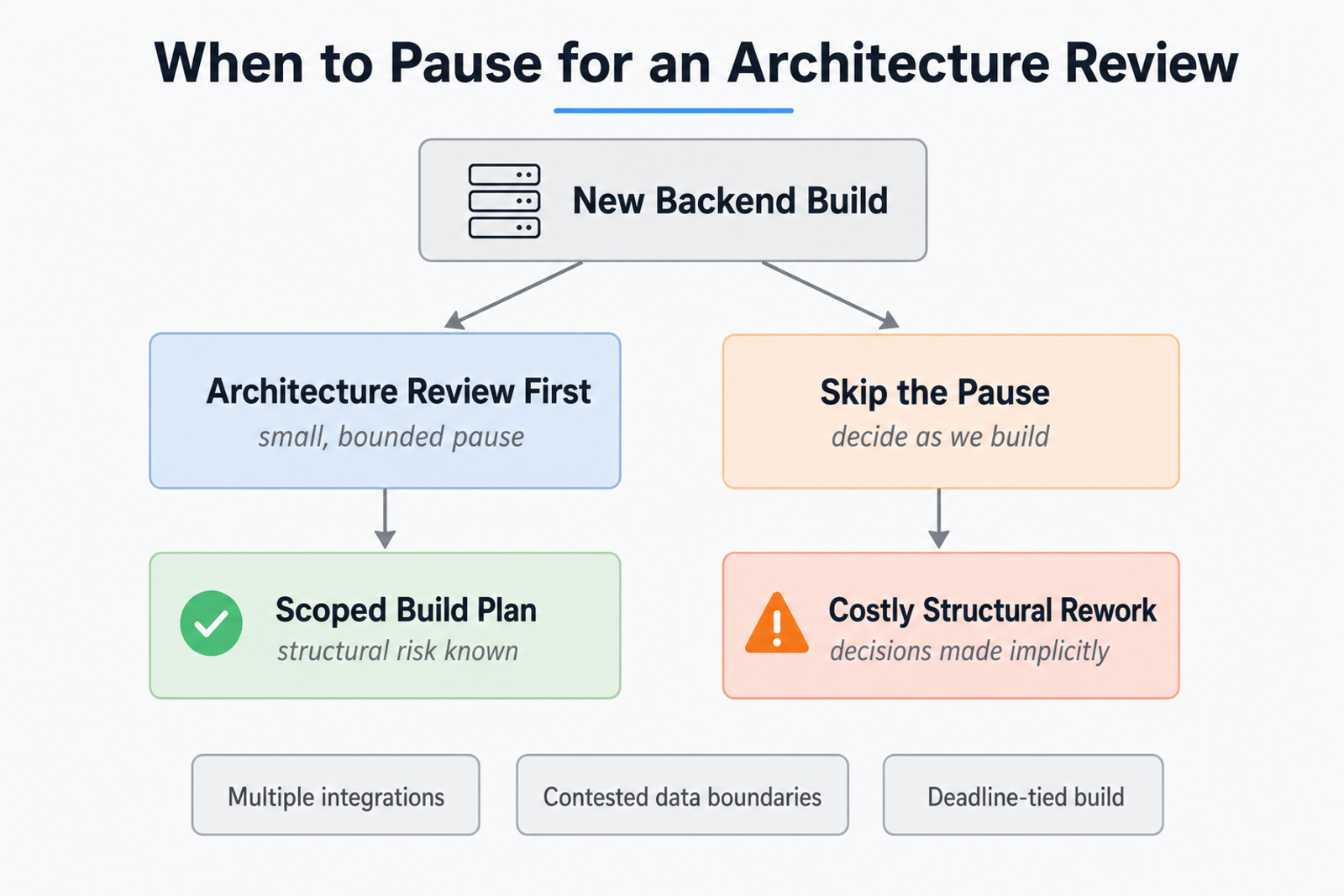
Most backend build commitments get made before the right questions get asked.
Teams pick a framework because someone on the team already knows it. They pick a database because the last project used it. They pick a deployment target because it is the path of least resistance for the current sprint.
None of these are bad decisions on their own. The problem is that each of them is an architecture decision. And architecture decisions made implicitly tend to be wrong by accident rather than wrong by design.
By the time the team notices, the structure is already in production. Reversing it is no longer a refactor. It is a rewrite.
The question worth asking before any meaningful backend build is not “what should we use?” It is “do we understand what we are committing to clearly enough to build it?”
For many teams the honest answer is no, and the gap is usually knowable in advance.
The Cost of Skipping the Architecture Question
When teams move directly to implementation, the cost rarely shows up immediately. It shows up later, in shapes that are hard to attribute back to the original decision.
- scope creep that looks like product churn but is actually architectural debt
- performance ceilings that only appear under real production load
- integration points that calcify and become expensive to change
- domain boundaries drawn around code structure instead of business reality
- workflows that quietly depend on assumptions no one wrote down
These costs are not unusual. They are the default outcome when the first round of architecture decisions is made by accumulation rather than by design.
In the worst case, the resulting system becomes a candidate for rewriting a system that is already in production, which is itself one of the most expensive ways to recover from a structural mistake.
Why “We Will Figure It Out as We Build” Often Fails
The instinct to start building is understandable. Code feels like progress. Architecture work feels like delay.
In short engagements this works. A small service with a known shape and one consumer rarely needs a structured review.
In larger engagements it fails for a specific reason: the decisions that matter most are not local to any single sprint. They cross teams, services, and data boundaries. Sprint planning is the wrong surface to make them on.
When architecture gets decided implicitly during sprint planning, the team is usually optimizing for the next two weeks of work. The result is a system that ships on time and degrades on a longer timeline.
Signals That You Need an Architecture Review First
Some builds carry enough structural risk to deserve a bounded pause before code is written. The signals are concrete, not abstract.
Consider an architecture review first if any of the following are true:
- the system spans more than one critical external integration
- data shape or domain boundaries are unclear or actively contested inside the team
- the team has competing opinions on framework, database, or deployment target
- there is a deadline, customer commitment, or investor checkpoint tied to the build
- a previous build attempt produced a system that already needs to be replaced
- the team is small enough that a wrong structural call will be expensive to reverse
- the system must integrate with legacy or third-party systems whose real behavior is not fully mapped
The last signal deserves particular care. When a new system has to coexist with code that already runs in production, the next build becomes as much a migration problem as a construction one. That class of work is rarely safe to start without a structured plan.
One signal is usually enough to justify a short, scoped review. Two or more is a strong indication that starting without one will cost more later than pausing now.
What an Architecture Review Should Actually Produce
A useful architecture review is not a research project. It is a structured set of decisions, captured in artifacts the team can actually use.
The output should include:
- a workload profile based on expected traffic, data volume, and failure modes
- a data and integration model that names the boundaries between services and external systems
- a technical risk surface that flags the parts of the system most likely to drive future rework
- a decision log that records each major tradeoff explicitly, with the alternatives considered
- a scoped build plan that translates the structural decisions into a concrete delivery sequence
If a review does not produce artifacts the team will reference during the build, it was not a review. It was a meeting.
What It Should Not Try to Do
A useful review is also defined by what it does not cover. It is not a full specification, not a delivery plan for every feature, not an open-ended consulting engagement that grows until the scope is unrecognizable.
The point is to remove the structural decisions most expensive to defer, and only those. Everything else stays the responsibility of normal delivery. A review that stays small is one the team will actually use.
When You Do Not Need One
Not every backend build needs a structured review.
Skip it when the work is genuinely contained:
- small internal tools with no external integrations
- single-purpose services with one clear consumer
- prototypes intended to be discarded after a specific test
- teams with strong existing senior judgment and a recent track record on similar systems
- workflows where the architecture has already been proven in production at the same shape
In these cases, adding a review introduces process where none is needed. The honest answer is sometimes that the build is ready, the team is ready, and the right move is to start. Selective process is part of what makes structured process worth doing in the first place.
A Decision That Compounds
A wrong line of code costs a refactor. A wrong boundary between two services costs months. A few principles tend to hold across most builds:
- architecture decisions compound faster than code decisions
- the cost of pausing is small; the cost of an unrecoverable structural mistake is large
- a review is a delivery-protection step, not a sales process
- whether a build belongs in the “review first” bucket is usually knowable in advance
The teams that ship most reliably are not the ones with the most rules. They are the ones who notice when a decision is structural and treat it differently when it is.
If any of the signals above feel familiar, the next step usually is not writing code. It is deciding what is actually being built.
For teams approaching that decision, the right starting point is a structured backend planning step rather than another sprint.