Legacy system migration is one of the most common engineering challenges in growing software companies. Systems become fragile, tightly coupled, and harder to change with confidence.
The instinctive reaction is often the same: rewrite it.
However, full rewrites frequently fail, not because the new technology is wrong, but because the migration strategy misunderstands how production systems actually evolve.
Legacy systems accumulate years of operational knowledge. Business rules, edge cases, and survival adaptations get embedded directly into the software.
What looks like bad architecture often represents history the system needed in order to keep working.
Why Full Rewrites Often Fail
Most rewrite efforts begin with a simplified mental model of the system. Engineers inspect the codebase, identify architectural problems, and design a cleaner replacement.
The challenge is that production systems rarely behave exactly as their code suggests. Operational pressure introduces subtle behaviors that become essential to stability.
When a rewrite begins, teams often reproduce the architecture they believe exists rather than the system that actually operates in production.
The new system may look correct in development and staging, then fail gradually as real-world conditions exercise behavior that was never rediscovered during the rewrite.
- defensive checks added after past incidents
- implicit assumptions about data ordering or timing
- workarounds for inconsistent external services
- edge-case handling discovered only through production failures
Migration Is Primarily a Risk Management Problem
Modernization is often framed as a technology upgrade. In practice, it is a risk management problem.
Production systems carry revenue, operational workflows, and customer expectations. Even small changes can introduce failure modes that are difficult to anticipate before deployment.
Replacing a large system all at once concentrates risk into a single moment. When problems appear, rollback becomes difficult because the old and new systems may already have diverged in behavior or data structure.
Safer migration strategies reduce this risk by evolving systems incrementally rather than replacing them wholesale. The objective is not architectural perfection. The objective is controlled change.
A Safer Approach to Legacy System Migration
Successful modernization efforts typically follow a gradual strategy that allows systems to evolve while remaining operational.
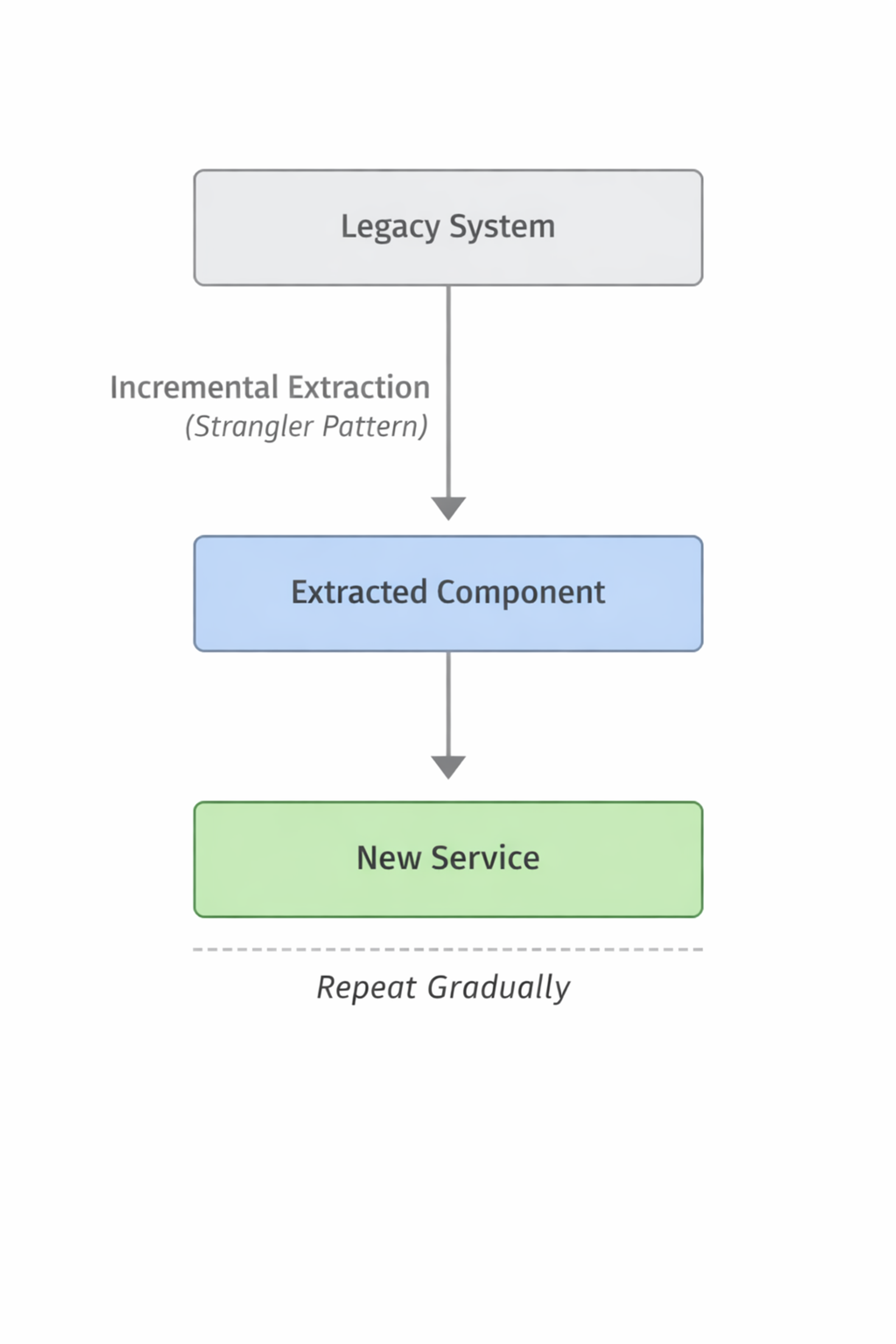
First, unstable or high-risk areas of the system are identified. Next, clearer boundaries are introduced around those components. Once boundaries exist, teams can begin extracting functionality gradually.
Backward compatibility becomes critical during this transition. Existing workflows must continue functioning while new components are introduced.
This incremental strategy reduces the blast radius of each change and allows teams to observe real production behavior before moving further.
Observability Before Migration
One of the most common migration mistakes is beginning structural changes without understanding how the system behaves in production.
Migration without observability is effectively blind refactoring. Before moving critical workflows, teams need visibility into where failures occur, which workflows create the most operational risk, and which components carry the highest production load.
Production data often contradicts architectural assumptions. Migration priorities should be guided by real production behavior rather than theoretical diagrams.
Principles for Safer Legacy System Modernization
- Stabilize the system before attempting major structural change.
- Measure production behavior before redesigning it.
- Introduce clear boundaries before extracting components.
- Preserve compatibility during the transition period.
- Migrate high-risk workflows gradually rather than all at once.
These principles allow systems to evolve safely without disrupting the business operations they support.
Respecting the History Inside Production Systems
Legacy systems rarely survive by accident. Most have endured years of operational pressure, changing requirements, and unexpected real-world conditions.
The goal of modernization is not to erase that history. Strong teams treat legacy systems as repositories of operational knowledge that must be preserved even as the architecture evolves.
Modernization succeeds when systems are allowed to evolve carefully, carrying forward the lessons embedded inside the software that has already survived production.
If the system matters to operations, migration strategy should be designed around reliability, observability, and controlled change, not around the appeal of starting over.