
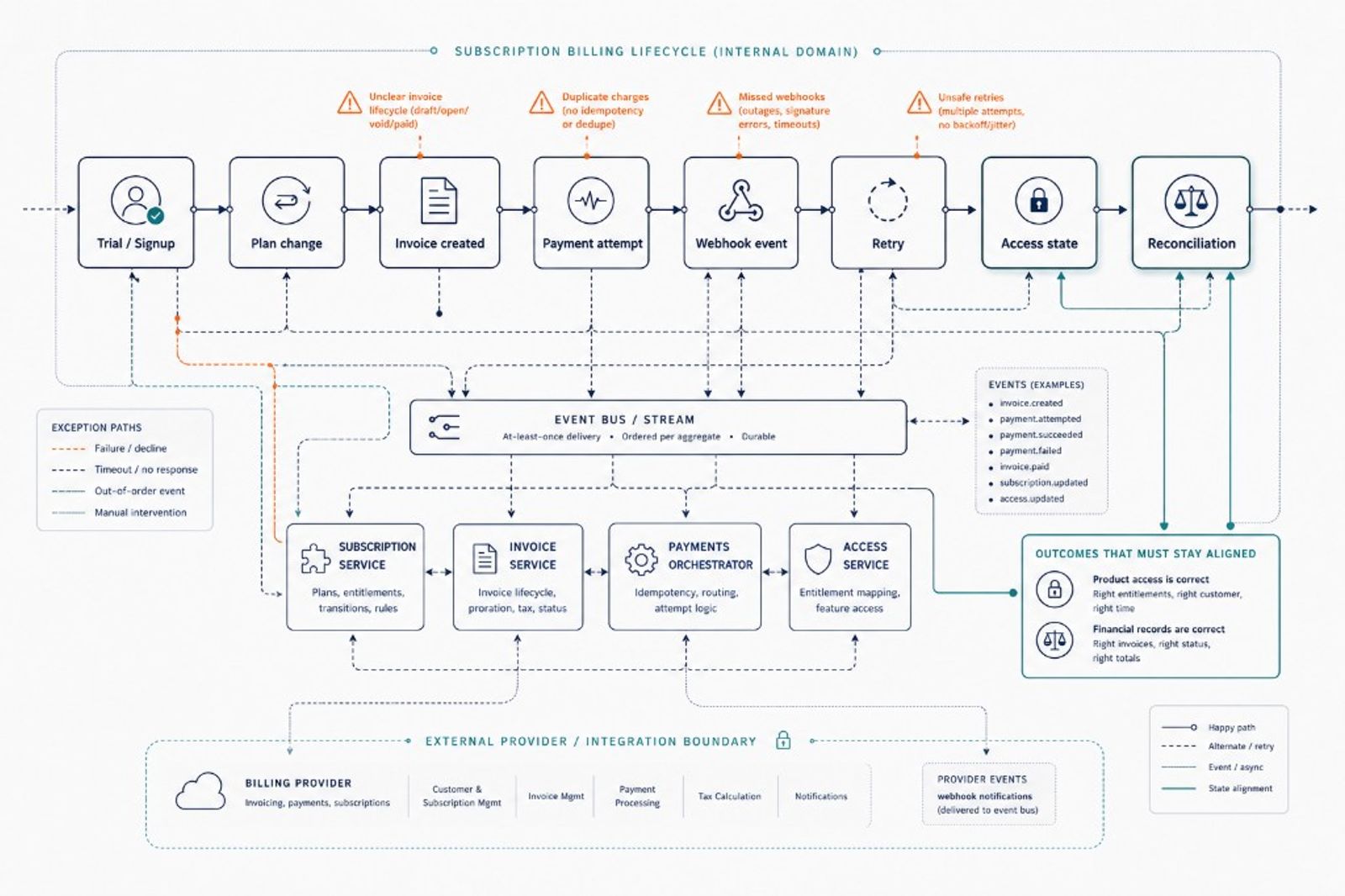
Subscription billing looks simple until the first edge case matters.
A customer changes plans in the middle of a cycle. A webhook arrives twice. An invoice payment succeeds after the product already marked the account as past due. A retry fixes one issue and creates another. A refund is issued, but the internal ledger never reflects the adjustment.
These are not rare cases. They are normal subscription-platform realities. The mistake is treating them as provider details instead of product architecture decisions.
Mistake 1: Treating The Billing Provider As The Whole System
A billing provider can calculate invoices, process payments, and emit events. It cannot decide every internal product rule for you. Your platform still needs to know what a subscription means, what states matter, which events change customer access, which records support reporting, and which exceptions require review.
The safest pattern is to treat the provider as an important external system, not as the entire operating model.
Mistake 2: Weak Duplicate-Charge Protection
Duplicate charges usually come from unclear event boundaries. A user action, server retry, webhook replay, or background job may all attempt to perform the same business operation.
- Use idempotency keys for operations that can be submitted more than once.
- Record provider event IDs and internal event IDs where each serves a different purpose.
- Make status transitions safe to repeat when repeat delivery is possible.
- Avoid triggering financial side effects from UI state alone.
Mistake 3: Underestimating Webhooks
Webhooks are not guaranteed to arrive in the order your product wishes they would. They can be delayed, duplicated, missed, retried, or received while another part of the system is changing the same customer record.
A strong webhook design validates the event, records receipt, handles idempotency, applies only safe state transitions, and creates an exception when the event cannot be reconciled with the current product state.
Mistake 4: Retrying Without A State Model
Retries can make a system more reliable, but only when the system knows what state it is retrying from and what side effect it is allowed to repeat.
Retry rules should distinguish between network failures, provider uncertainty, validation failures, business-rule failures, and review-required exceptions. Treating all failures the same turns reliability code into a billing risk.
Mistake 5: Ignoring The Invoice Lifecycle
Invoices have a lifecycle. Draft, open, paid, failed, voided, credited, adjusted, and partially reconciled states may all matter depending on the product. If the platform only stores one simplified status, support and operations may have no way to explain what happened.
The invoice lifecycle should connect to customer access, notifications, retries, reconciliation, reporting, and downstream handoffs. Those connections need to be explicit before the product starts scaling.
Mistake 6: No Reconciliation View
A subscription platform needs a way to compare internal product state with provider state and downstream records. Without that, the team may discover billing drift only through customer complaints or manual cleanup.
ProVia Hub helps SaaS companies and founders design these boundaries through Financial Systems & Payment Infrastructure, often connected to SaaS / MVP or Technical Backend work.
Subscription billing architecture should make the business safer as it grows. That means designing the lifecycle, webhook handling, retries, duplicate-event protection, and reconciliation process as one system, not as separate cleanup tasks.