A business platform becomes long-lived when it keeps absorbing new workflows without losing its structure.
At the beginning, most platforms look simple. A few roles, a few forms, a few status changes, a few integrations. Then the business grows. More edge cases appear. More people depend on the system. More tools need to connect. More reports need to match reality.
The platforms that survive that growth are not perfect. They are designed so their important decisions remain visible and changeable.
Maintainability Starts With Boundaries
Maintainability is not only clean code. It is the ability to understand what part of the system owns a business rule.
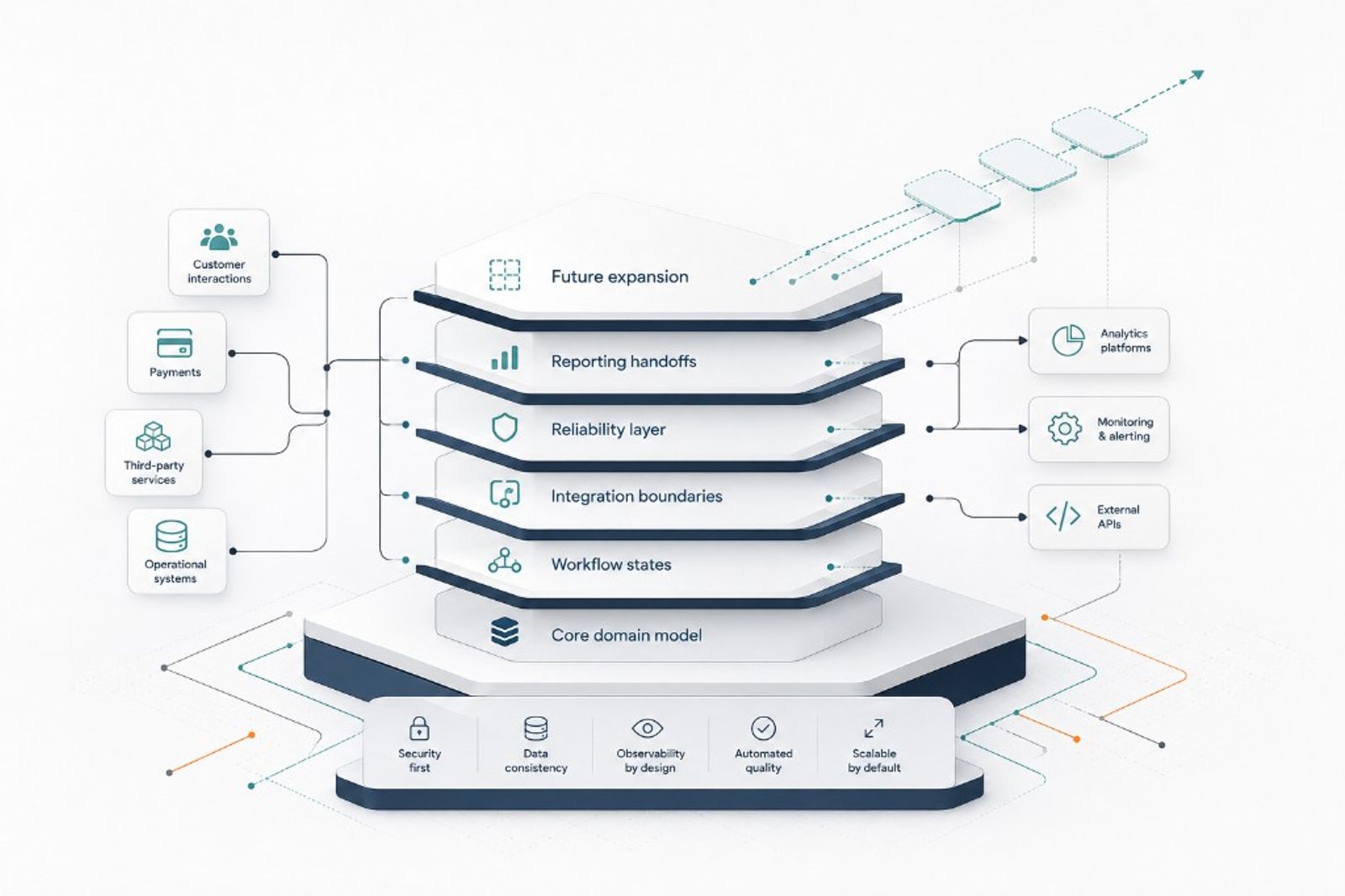
When billing logic, workflow state, permissions, notifications, and reporting rules are scattered across unrelated components, every change becomes risky. A maintainable platform has clear ownership boundaries: which service owns the record, which event changes the state, which workflow triggers the handoff, and which integration receives the result.
This is why ProVia Hub often starts with architecture clarity before build work. The goal is to make the system understandable before it becomes expensive to change. See Technical Backend & System Stabilization for the broader backend path.
Scalability Is More Than Traffic
Many teams think scalability means handling more users. That matters, but business-platform scalability is also about handling more workflows, more roles, more exceptions, more data movement, and more operational responsibility.
- Can a new workflow be added without breaking existing states?
- Can a new integration receive clean events without becoming the source of truth?
- Can reporting grow without depending on manual cleanup?
- Can the platform explain what happened when a workflow goes wrong?
Reliability Comes From Explicit Failure Paths
Reliable systems are not systems where nothing fails. They are systems where failure is anticipated, contained, retried when safe, and surfaced when review is needed.
For long-lived platforms, this means designing around delayed third-party responses, duplicate events, failed notifications, partial handoffs, permission mismatches, and operational exceptions. Reliability improves when those states are part of the model rather than surprises in production.
Integrations Need Ownership Rules
Integrations often become fragile because teams connect tools before deciding which system owns which fact. A CRM, accounting system, dashboard, product database, and operational workflow can all represent related information, but they should not all be allowed to redefine the same truth.
Before integrating systems, define the ownership rules. Which system creates the record? Which system updates status? Which system receives a downstream handoff? Which system is allowed to disagree, and how is that exception reviewed?
For operational workflows, this connects directly to Business Systems. For SaaS products and founder-led platforms, it often connects to SaaS / MVP or financial systems architecture.
Long-Lived Platforms Are Built In Phases
The strongest platforms are usually not built all at once. They grow through disciplined phases: clarify the operating model, define the architecture, build the smallest useful foundation, observe real usage, then expand where the business case is clear.
That phased approach is less dramatic than a big rebuild promise, but it protects the platform from accidental complexity. It also gives founders and teams better decision points as the system becomes more important to the business.