
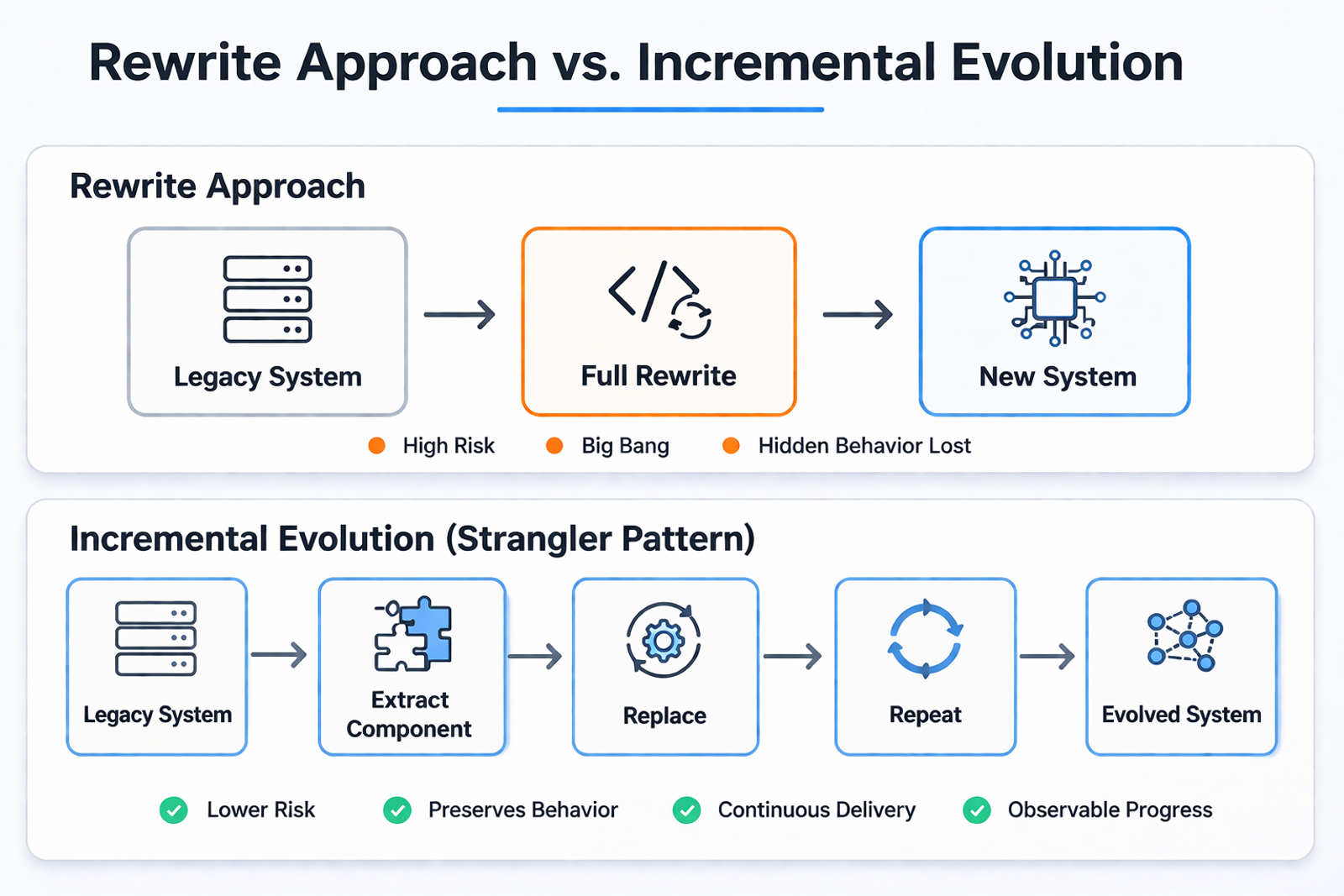
At some point, most engineering teams reach the same conclusion.
The system feels fragile. Changes are risky. Velocity slows down.
So the idea emerges: let’s rewrite it.
On the surface, rewriting feels like the cleanest path forward. A fresh architecture promises clarity. In practice, it is rarely that simple.
The difference between rewriting and evolving a system is not just technical. It is how risk gets introduced into production.
One approach concentrates risk into a single moment. The other distributes it over time.
The Illusion of Understanding
Rewrites usually begin with confidence. The team reads the codebase, identifies structural issues, and designs a cleaner system intended to replace it.
But production systems are not defined only by their code. They are shaped by years of real-world behavior and survival logic.
Much of that knowledge is never documented. It exists because the system has already survived production.
A rewrite often captures what the system looks like, not how it actually behaves.
- edge cases discovered through failure
- defensive logic added after incidents
- assumptions about timing, ordering, and retries
- workarounds for unreliable external systems
Where Rewrites Break
New systems rarely fail immediately. They pass tests, they work in staging, and they look correct in isolation.
The failures appear later under real load, partial outages, and the exact edge cases the original system had already learned to survive.
At that point, the problem is not just bugs. It is missing behavior.
Rewrites Concentrate Risk
The biggest issue with rewriting is not technical. It is structural.
A full rewrite replaces a distributed set of learned behaviors with a single moment of change. That concentrates risk into deployment.
What was once a gradual, evolving system becomes a binary switch.
- rollback is difficult
- data may already have diverged
- the old system no longer reflects current reality
Why Teams Still Choose It
Rewrites are attractive because they feel decisive. They promise clarity, create a sense of progress, and simplify messy systems into something easier to reason about.
But they also remove the safety net that allowed the system to evolve in the first place.
A More Reliable Path
Most successful modernization efforts do not begin with rewriting. They begin with understanding.
Before changing architecture, teams need to observe real production behavior, identify where risk actually exists, isolate unstable components, and introduce clearer boundaries.
From there, change becomes incremental. New components take over gradually, behavior is validated in production, and risk is distributed over time.
The Real Goal
Modernization is not about clean architecture. It is about controlled change in systems that already carry business-critical behavior.
Legacy systems are not just technical artifacts. They are repositories of operational knowledge.
Rewriting them without understanding that knowledge is not simplification. It is loss.
In most cases, the question is not “Should we rewrite the system?”
It is “How do we change it without breaking what we do not fully understand?”
If you are dealing with a legacy system and considering a rewrite, the hidden risk is usually not architecture alone. It is production behavior you have not mapped yet.