Most payment problems do not begin with the payment provider. They begin with unclear system ownership.
A platform can use a strong billing provider and still lose money through duplicate events, missing updates, manual exceptions, weak audit trails, and reconciliation gaps. The provider may process the transaction correctly while the product records the wrong state, misses a webhook, retries the wrong operation, or gives operations no way to explain what happened.
That is why payment workflow design should start before implementation. The important question is not only how money moves. It is how the platform records, confirms, retries, reconciles, and audits every event around that movement.
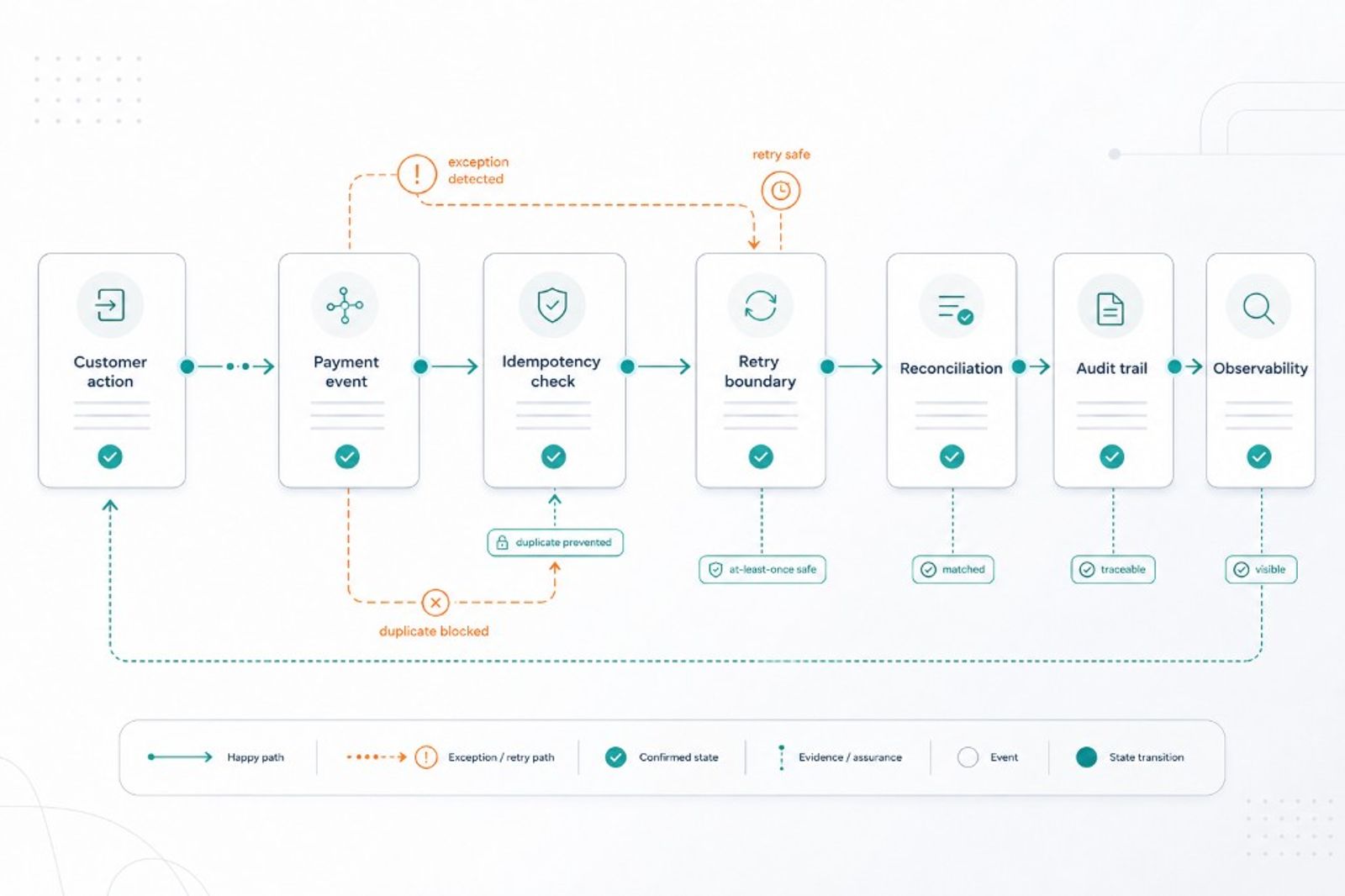
Idempotency Is Not Optional
Any payment workflow that can receive the same event twice needs an idempotency rule. That includes customer checkout actions, webhook handlers, invoice updates, refund requests, adjustment flows, and background jobs.
Without idempotency, a retry can become a duplicate charge, duplicate credit, duplicate ledger entry, or duplicate notification. The visible damage may look like a billing mistake, but the root problem is usually that the system did not know whether it had already handled the same business event.
- Define a stable event key before writing side effects.
- Record the processing state of critical events.
- Make retry behavior safe before adding retry behavior.
- Separate provider event IDs from internal business-event IDs when both matter.
Retries Need Boundaries
Retries are useful only when the system knows what is safe to repeat. Retrying a failed network call is different from retrying a state transition that may have already succeeded elsewhere.
A reliable payment workflow distinguishes between transient failures, provider uncertainty, validation failures, and business-rule failures. Each class needs a different response. Some failures should retry automatically. Some should stop and create an exception. Some should wait for a later provider event. Some should never retry without human review.
Reconciliation Is A Product Requirement
Reconciliation should not be an afterthought handled in a spreadsheet after the platform is already live. If payments, invoices, credits, settlements, and adjustments matter to the business, the product needs a way to compare what it believes with what downstream systems report.
- What did the platform expect to happen?
- What did the provider report happened?
- What reached accounting, ERP, reporting, or another downstream system?
- Which differences are expected timing gaps and which are real exceptions?
Auditability Builds Trust
When money-related state changes are hard to explain, every support issue becomes expensive. The system should show who or what changed a state, when it happened, what event caused it, and what downstream handoff followed.
Auditability does not require overbuilding. It requires deciding which events are important enough to trace and making that trace visible to the people responsible for review.
Observability Keeps The System Honest
Payment workflows need observability around queues, webhook failures, retry counts, reconciliation exceptions, latency, and event volume. Without those signals, the first alert may come from a customer, founder, or accounting cleanup task.
For SaaS companies and founders, ProVia Hub treats this as part of Financial Systems & Payment Infrastructure, connected to backend architecture, workflow clarity, and Financial System Integrity.
The safest payment systems are not the ones with the most automation. They are the ones where every important event has ownership, traceability, retry boundaries, and a way to reconcile reality against the system record.