
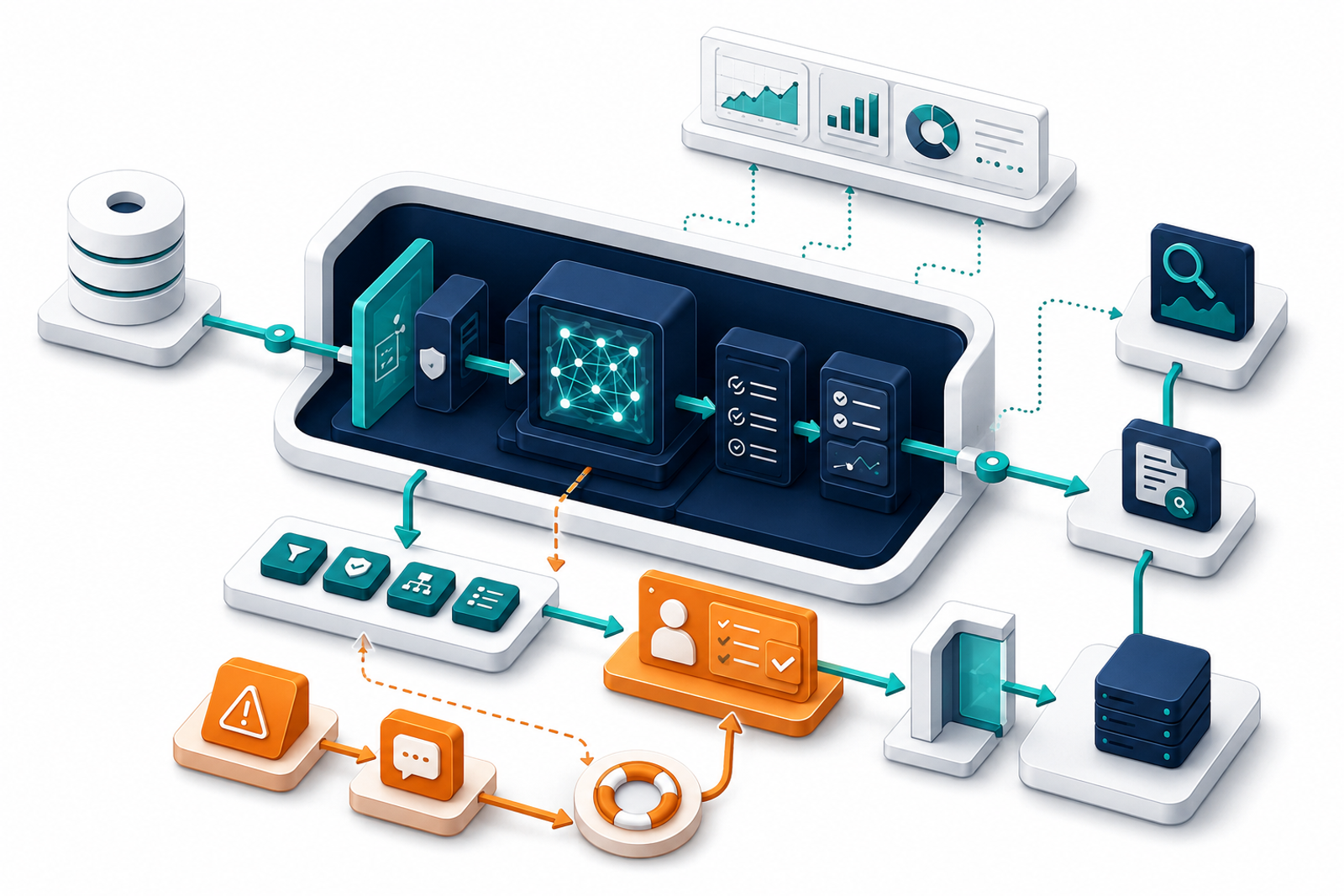
A convincing AI workflow demo proves that a model can produce a useful result under selected conditions. It does not prove that the surrounding system is ready for production.
Production introduces responsibilities the prompt cannot carry: deciding which data is authoritative, limiting what the model can see and change, evaluating behaviour over time, handling uncertainty, observing failures, protecting sensitive information, and recovering when an output is wrong.
The model is one component. Reliability depends on the operating and software boundaries around it.
Start with a real workflow, not a general AI capability
A production use case should describe a specific task, actor, input, decision boundary, and expected result. “Use AI for operations” is not a workflow. “Draft a summary of an approved case record for a human reviewer” is closer because the system can define what the model receives, what it may produce, and who remains responsible.
A useful scope answers:
- Which event invokes the AI step?
- Which records and instructions form its permitted context?
- What output format is expected?
- What decisions may the model support but not make?
- Which actions require deterministic validation or human approval?
- What happens when confidence, data quality, or system availability is insufficient?
The source of truth must remain outside the model
A language model can interpret context, but it should not become the authority for customer state, workflow status, permissions, or business rules. Those belong in controlled systems and deterministic services.
The AI layer should receive the minimum relevant context from named sources. Retrieval should preserve record identity, access rules, timestamps, and version information. If two sources disagree, the workflow should surface the conflict rather than asking the model to choose silently.
Evaluation has to represent the real operating conditions
A few favourable examples are not an evaluation system. Teams need a representative set of normal cases, edge cases, ambiguous inputs, prohibited requests, and known failure conditions. The expected result should include more than whether the wording looks good.
Depending on the task, evaluation may measure:
- factual consistency with the supplied records;
- required fields and output structure;
- unsupported claims or omitted constraints;
- correct refusal or escalation behaviour;
- performance across different user groups or document types;
- latency, cost, and failure rates under realistic volume;
- the rate and severity of human corrections.
Model, prompt, retrieval, and policy changes should be tested against the same baseline before deployment. Production feedback should then add new failure cases to that evaluation set.
Permissions should be narrower than the model’s apparent capability
An AI system may be able to draft, classify, retrieve, route, call tools, or propose changes. That does not mean one workflow should grant all of those capabilities.
Use least-privilege access. Separate read tools from write tools. Validate tool arguments outside the model. Require confirmation for consequential actions. Restrict destinations, record types, and amounts where applicable. Important state changes should pass through the same authorization and audit controls as any other production action.
This boundary matters because unexpected, ambiguous, or manipulated inputs can produce inappropriate tool use. More autonomy increases the number of failure paths the surrounding system must contain.
Human review must be designed, not assumed
“A human is in the loop” is meaningful only when the reviewer has enough context, time, authority, and interface support to detect a bad result.
A review step should make visible:
- the source records used to generate the output;
- important uncertainty, missing context, or conflicting data;
- the exact change or communication being proposed;
- the consequences of approval;
- a safe way to edit, reject, or escalate;
- an audit record of the final human decision.
Low-risk tasks may allow automated completion after strong validation. High-impact or difficult-to-reverse actions usually need explicit review or a deterministic rule that prevents unsafe execution.
Observability must connect model behaviour to business outcomes
Application logs should record enough information to reconstruct what happened without exposing sensitive prompt or customer data unnecessarily. Useful signals include model and prompt versions, retrieval sources, tool calls, validation failures, reviewer corrections, latency, cost, fallback use, and the resulting workflow state.
A healthy API response is not proof that the workflow is correct. Teams also need invariant monitoring: required approvals were present, prohibited actions did not occur, records remained consistent, and downstream events completed as expected.
Fallback and recovery are product features
Models, providers, retrieval systems, and integrations will sometimes be slow, unavailable, or wrong. The workflow needs a defined degraded mode.
That may include:
- returning the task to a manual queue;
- using a deterministic template instead of generated text;
- preventing a write while preserving the draft and context;
- retrying only when the operation is safe and idempotent;
- reconciling partially completed actions;
- rolling back a configuration or model version;
- notifying an owner when the error requires investigation.
A practical readiness sequence
- Define the workflow, risk, owner, and prohibited outcomes.
- Identify the authoritative records and permission boundaries.
- Start with decision support or drafting before irreversible automation.
- Build a representative evaluation set and explicit acceptance thresholds.
- Place deterministic validation and authorization around model output.
- Design human review, fallback, and recovery paths.
- Instrument the workflow and monitor business invariants in production.
- Expand autonomy only when evidence shows the existing boundary is dependable.
This approach is consistent with established AI risk guidance that emphasizes defined scope, evaluation, monitoring, human oversight, and controlled permissions. It is also intentionally conservative: the cost of a manual review is often lower than the cost of an unexplained production action.
Production readiness is a systems property
Better prompts can improve output quality. They cannot create trustworthy source data, enforce authorization, reconcile partial failures, or make an unsafe workflow recoverable.
Production-ready AI emerges when the model operates inside a system that knows what is true, what is permitted, how quality is measured, when a person must decide, and how the business recovers when the result is imperfect.
If you are evaluating AI-assisted summaries, classification, routing, drafting, or decision support inside a real workflow, explore Business Systems to define the operating and source-of-truth boundaries first.