Operational data rarely becomes unreliable at the moment a dashboard shows the wrong number.
The damage usually begins earlier: when information enters the workflow, changes meaning, moves between systems, loses ownership, or fails to reconcile with the event it is supposed to represent.
By the time a report, automation, or AI assistant exposes the inconsistency, the team may have been operating around it for weeks. The visible error is only the final symptom of a boundary that was never made dependable.
Correct values can still represent the wrong reality
Data quality is often treated as a formatting problem: missing fields, duplicate rows, invalid dates, or inconsistent names. Those matter, but operational reliability requires a deeper question: does the record still mean what the workflow assumes it means?
A status can be valid and stale. A total can be calculated correctly from incomplete events. A customer record can be accurate in one system and outdated in another. A successful import can preserve the wrong type or remove information such as leading zeros. Technical validity is not the same as operational truth.
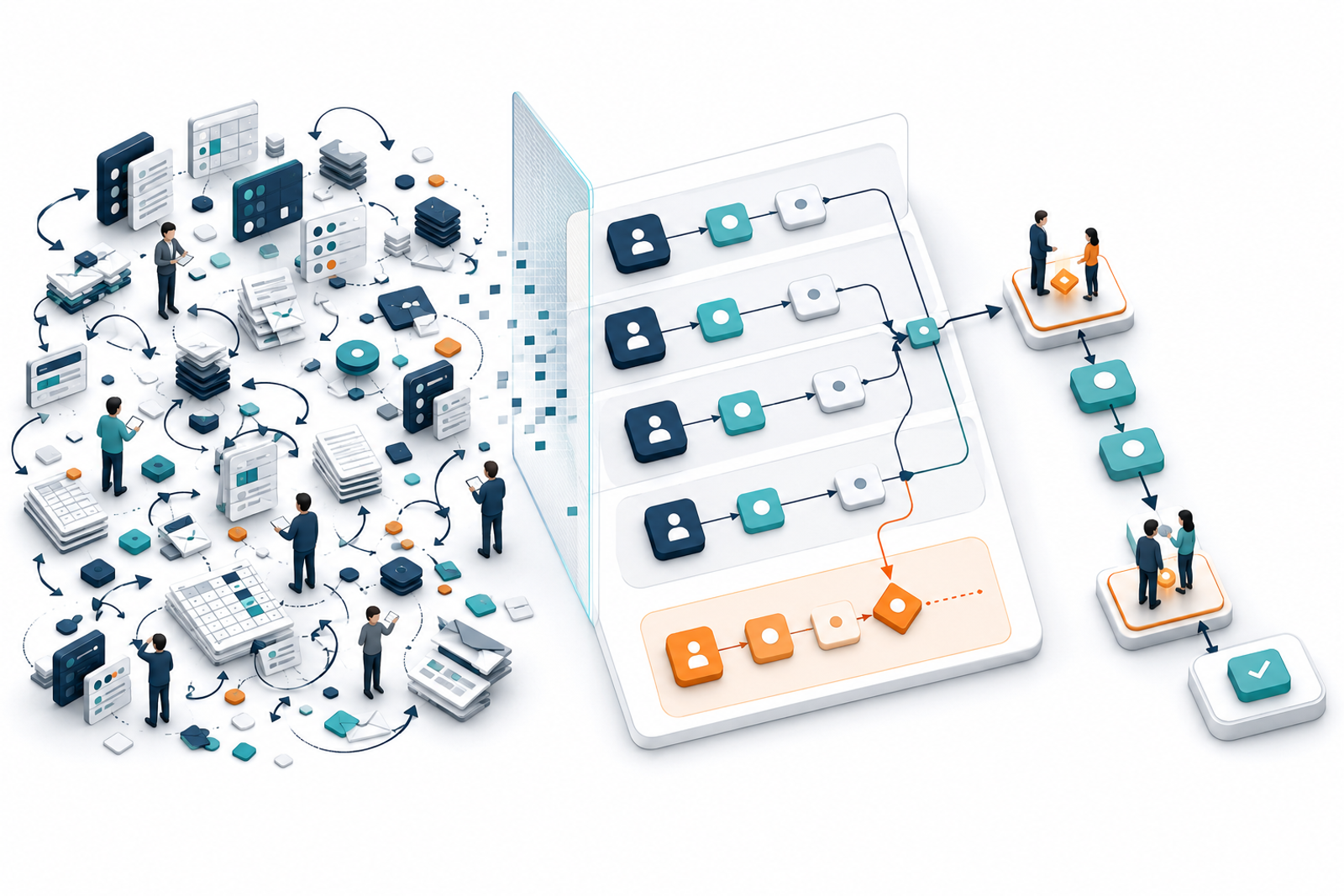
The boundaries where reliability starts to drift
1. Ingestion: the system accepts data before normalizing it
External files, forms, vendor APIs, and manual entry all bring assumptions. Dates use different formats. Identifiers are mistaken for numbers. Empty values mean different things. A field that began as numeric later contains text. If those inputs are interpreted implicitly, downstream logic can confidently operate on corrupted meaning.
A normalization layer should validate structure, preserve identifiers, reject ambiguous records, and make conversion rules explicit before business logic relies on the data.
2. Ownership: more than one place can change the same fact
Reliability weakens when several systems or teams can update a field without a clear authority rule. A contact status changes in a CRM, an operations sheet, and an inbox label. Each change may be reasonable, but the organization has no deterministic way to decide which one wins.
Every important record needs a named source of truth and an explicit rule for how other systems receive, cache, propose, or reconcile changes.
3. State transitions: the record skips the event that gives it meaning
A status is trustworthy only when the transition into it represents a real event. If users can mark work complete without required evidence, or an integration updates a status before the downstream action succeeds, the database records an intention rather than reality.
4. Handoffs: context is lost between people or systems
A workflow may transfer the record but omit the reason, exception, approval, or dependency needed by the next owner. The receiving system sees a valid object while the receiving person lacks the context required to act correctly.
5. Conversion: data changes type or precision silently
Imports and integrations frequently coerce values for convenience. Identifiers lose leading zeros. Timestamps change time zones. decimal values are rounded. Free text becomes a fixed category. These transformations can be technically successful and operationally destructive.
6. Reconciliation: systems disagree without creating an exception
Distributed workflows will eventually disagree. Messages arrive late, retries duplicate work, users correct one system but not another, and dependencies partially fail. Reliability depends less on preventing every difference than on detecting, explaining, and repairing important differences.
Why dashboards and AI make the problem more visible
Reporting tools aggregate the records they receive. AI systems summarize, classify, or reason over the context they are given. Neither layer can restore meaning that disappeared earlier in the pipeline.
A polished dashboard can create false confidence because the presentation is consistent even when the source definitions are not. An AI assistant can make the same problem more persuasive by producing a fluent explanation from incomplete or misclassified inputs.
The right response is not to distrust dashboards or AI. It is to make the upstream data contract, ownership, validation, and exception paths observable before adding another interpretation layer.
A practical reliability review
For each important operational record, ask:
- Where does this fact originate?
- Which system or role is allowed to change it?
- What business event makes the change true?
- Which validation or normalization occurs at entry?
- What information is lost when it moves to the next system?
- How are duplicates, late updates, and partial failures handled?
- How will the team detect disagreement between sources?
- Who can reconcile the record, and what evidence remains afterward?
These questions move data quality out of periodic cleanup and into system design. They also reveal where a simple workflow correction may create more value than a new analytics or automation layer.
Reliable data is an operating property
Operational data becomes dependable when the workflow preserves meaning from entry through decision, handoff, and recovery. That requires clear ownership and observable transitions, not only cleaner tables.
If a team cannot explain where a record came from, why its state changed, and how disagreement will be repaired, the data is already under pressure—even if the dashboard still looks correct.
If duplicated records, inconsistent statuses, or fragile reporting are obscuring operational truth, explore Business Systems to investigate the workflow and its source-of-truth boundaries.