Technical debt gets attention because it is visible.
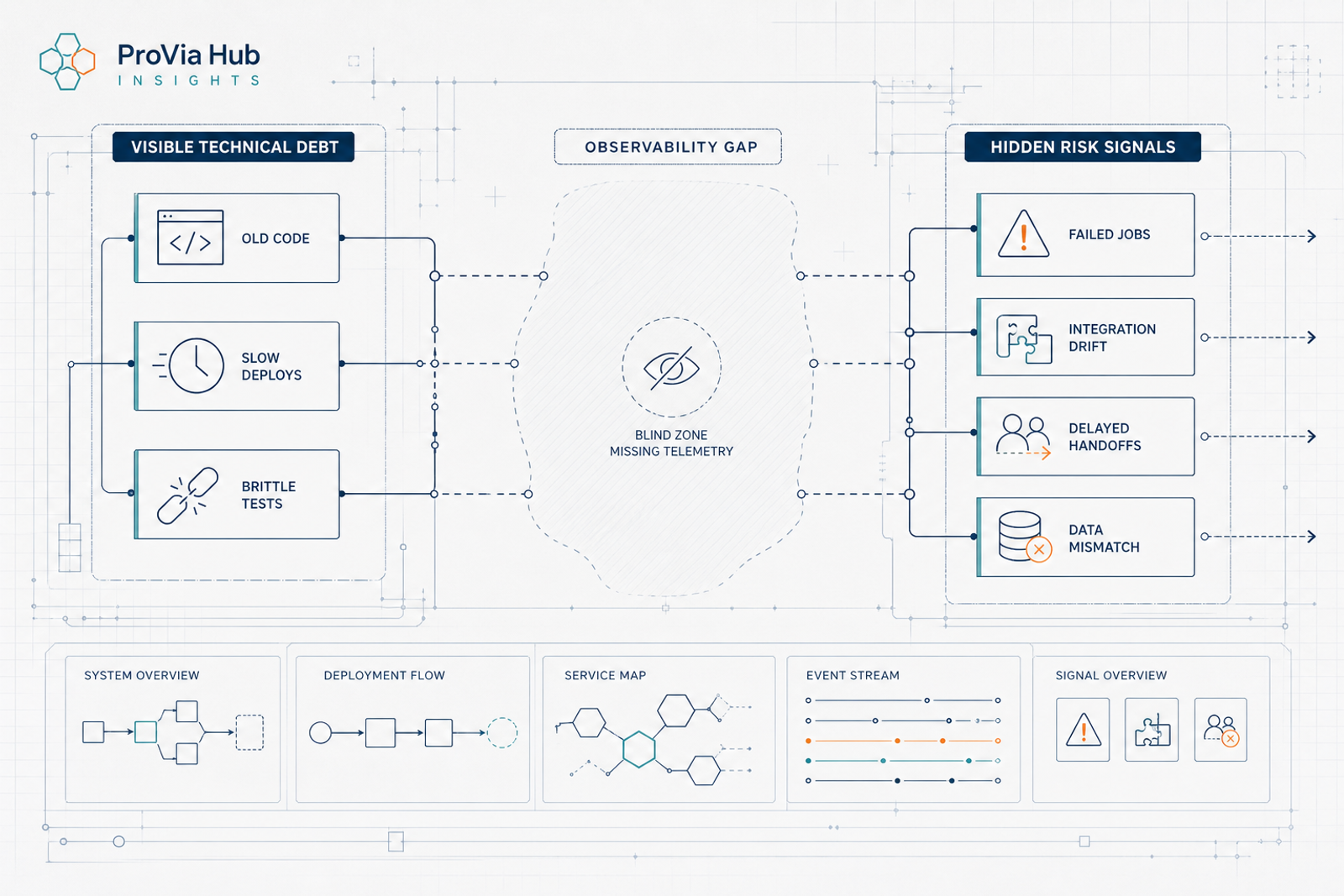
Teams can point to the old framework, the slow test suite, the duplicated logic, the risky deployment process, or the module nobody wants to touch. The discomfort is real, but at least the problem has a shape.
Observability gaps are different. They hide inside systems that still appear to be working. The dashboard is quiet. The backlog has other priorities. Customers may not be complaining yet. Operations may have learned to compensate manually.
That silence can be more dangerous than obvious technical debt, because it prevents the team from seeing where risk is already accumulating.
The question is not whether observability tools are installed. The better question is whether the business can see the system behavior that would change a technical or operational decision.
Why Technical Debt Gets Named First
Technical debt is easier to discuss because it usually leaves evidence engineers recognize.
- changes take longer than they should
- deployments require unusual caution
- tests are slow, brittle, or missing
- old abstractions no longer match the business
- integration code has become hard to reason about
Those signals matter. They can slow delivery, increase defects, and make future changes more expensive.
But technical debt is not always the highest-risk problem. Sometimes the bigger issue is that the team cannot see what the system is doing in production clearly enough to know which debt matters most.
That is where observability gaps become dangerous.
What Observability Gaps Actually Hide
An observability gap exists when important system or workflow behavior is happening, but the team cannot detect it, explain it, or connect it to business impact quickly enough.
This can show up in backend systems, operational workflows, integrations, dashboards, and internal processes. The common pattern is the same: the system has behavior that matters, but leadership and delivery teams cannot see it clearly.
Common examples include:
- failed background jobs that retry silently until downstream data is late
- integration errors that appear only as manual cleanup work in another tool
- customer-facing delays that never become incidents because no one measures the handoff
- workflow states that live in inboxes, spreadsheets, or staff memory instead of a source of truth
- performance degradation that is visible to users before it is visible to the team
- data mismatches that affect reporting, billing, inventory, or approvals without a clear owner
These issues are not always caused by bad code. Sometimes they are caused by missing signals, unclear ownership, or a system model that never captured the real operating path.
Why This Can Be Riskier Than Technical Debt
Technical debt can be uncomfortable without being urgent. Observability gaps can be quiet while already affecting revenue, trust, or delivery confidence.
The risk compounds because invisible problems distort planning. Teams optimize the wrong areas, modernize the wrong components, or rewrite parts of a system without understanding where production pressure actually lives.
That is one reason large modernization efforts often struggle. As noted in ProVia Hub’s article on legacy system migration, production systems carry behavior that diagrams and code review do not always reveal. Without visibility, migration becomes blind refactoring.
The same pattern appears when teams consider a rewrite. A rewrite may clean up visible architecture while losing invisible production knowledge. That is why incremental evolution is often safer than a full rewrite when system behavior is not fully mapped.
Observability does not eliminate technical debt. It tells the team which risks are real, which are theoretical, and which are already costing the business.
The Signals That Visibility Is Missing
Observability gaps rarely announce themselves directly. They show up as management and delivery symptoms.
- Incidents are explained by whoever happened to notice them first.
- Customer support, operations, and engineering disagree about what happened.
- The team knows something is slow, but not where the delay starts.
- Manual workarounds have become part of normal operations.
- Dashboards show totals, but not pending, blocked, overdue, or failed states.
- Integration failures are discovered through downstream complaints instead of system alerts.
- Architecture decisions are being made without production behavior evidence.
One or two of these may be manageable. Several together usually mean the system is carrying risk the team cannot currently measure.
What Good Observability Should Reveal
Useful observability is not just logs, metrics, and traces. Those matter, but the business value comes from seeing the right system behavior at the right level of decision-making.
For a backend or product system, the team should be able to see:
- where failures occur
- which workflows are slow or fragile
- which integrations fail, retry, or drift out of sync
- which data states are incomplete, invalid, or delayed
- which incidents repeat and why
For an operations-heavy business, visibility may need a different shape. The important questions may be:
- what is pending, blocked, overdue, or unassigned
- where handoffs depend on manual memory
- which workflow events affect accounting, inventory, reporting, approvals, or client follow-up
- where dashboards summarize activity without showing risk
In both cases, the principle is the same. The system should expose the behavior that affects decisions.
How To Respond Without Overbuilding
The answer is not to buy more tools by default. Adding observability software without understanding the system can create more noise than clarity.
A better starting point is bounded investigation.
- Map the critical workflows that carry revenue, delivery, compliance, customer trust, or operational load.
- Identify where failures, delays, retries, or manual cleanup are currently invisible.
- Separate technical signals from operational signals so the right team owns the right problem.
- Stabilize the riskiest paths before making major architecture or automation decisions.
- Decide whether the next step is backend stabilization, architecture review, or operational systems assessment.
This is the same logic behind asking whether a backend needs an architecture review before the next build. The point is not process for its own sake. The point is to stop expensive decisions from being made while the most important system behavior is still hidden.
Visibility Before Bigger Commitments
Teams often want to fix technical debt, modernize the backend, add automation, or build dashboards. Those may be the right moves, but only after the real risk is visible.
If the issue is production reliability, failing integrations, deployment risk, or unclear backend behavior, the right next step is usually a Technical Backend path focused on diagnosis, stabilization, architecture, or phased modernization.
If the issue is operational state, handoff visibility, ownership, dashboard clarity, or workflow control, the better starting point may be a Business Systems path that maps the operating layer before automation or tooling decisions.
Technical debt is expensive when it slows change. Observability gaps are expensive when they hide what change should happen next.
For systems that matter to revenue, delivery, or client trust, visibility is not a nice-to-have layer. It is the starting point for responsible technical judgment.
If the system is important and the risk is unclear, start by making the behavior visible before building around assumptions.