Not every painful workflow needs a long investigation.
If the process is understood, one system clearly owns the data, exceptions are rare, and the change is easy to reverse, a small implementation may be the responsible next step.
Investigation becomes valuable when the team cannot explain the current operation well enough to know what the implementation should preserve, replace, connect, or leave manual. At that point, building is not progress. It is a way of turning assumptions into software.
Signal 1: ownership changes depending on who you ask
One person believes sales owns the request until payment. Another believes operations owns it after intake. A third relies on a spreadsheet maintained outside both teams. When ownership is ambiguous, automation can move work without creating accountability.
Signal 2: statuses do not mean the same thing everywhere
“Approved,” “ready,” “paid,” or “complete” may have different meanings across email, CRM, project tools, accounting records, and reporting. A new integration will not resolve that semantic mismatch. It may make the disagreement harder to see.
Signal 3: exceptions are handled from memory
The normal workflow looks simple, but experienced staff know when to pause, ask for another document, retry a handoff, or correct a record manually. Those exception rules are part of the real system even when they are not documented.
Signal 4: data is copied because no source is trusted
Repeated copying is often treated as a productivity problem. It may actually be an ownership problem. Before eliminating the manual step, determine which record is authoritative, which fields may change elsewhere, and how conflicts should be resolved.
Signal 5: a downstream system raises the stakes
A workflow may feed billing, payments, accounting, inventory, reporting, contracts, or customer communication. Errors then travel beyond the original team. Investigation should define the handoff and approval boundary without pretending to replace those downstream systems or provide tax, accounting, or ERP advice.
Signal 6: the proposed solution keeps changing
If every conversation produces a different tool, dashboard, AI agent, integration, or custom-app idea, the team probably has not agreed on the problem boundary. Choosing technology will not settle the operating question.
What an Operational Systems Assessment should produce
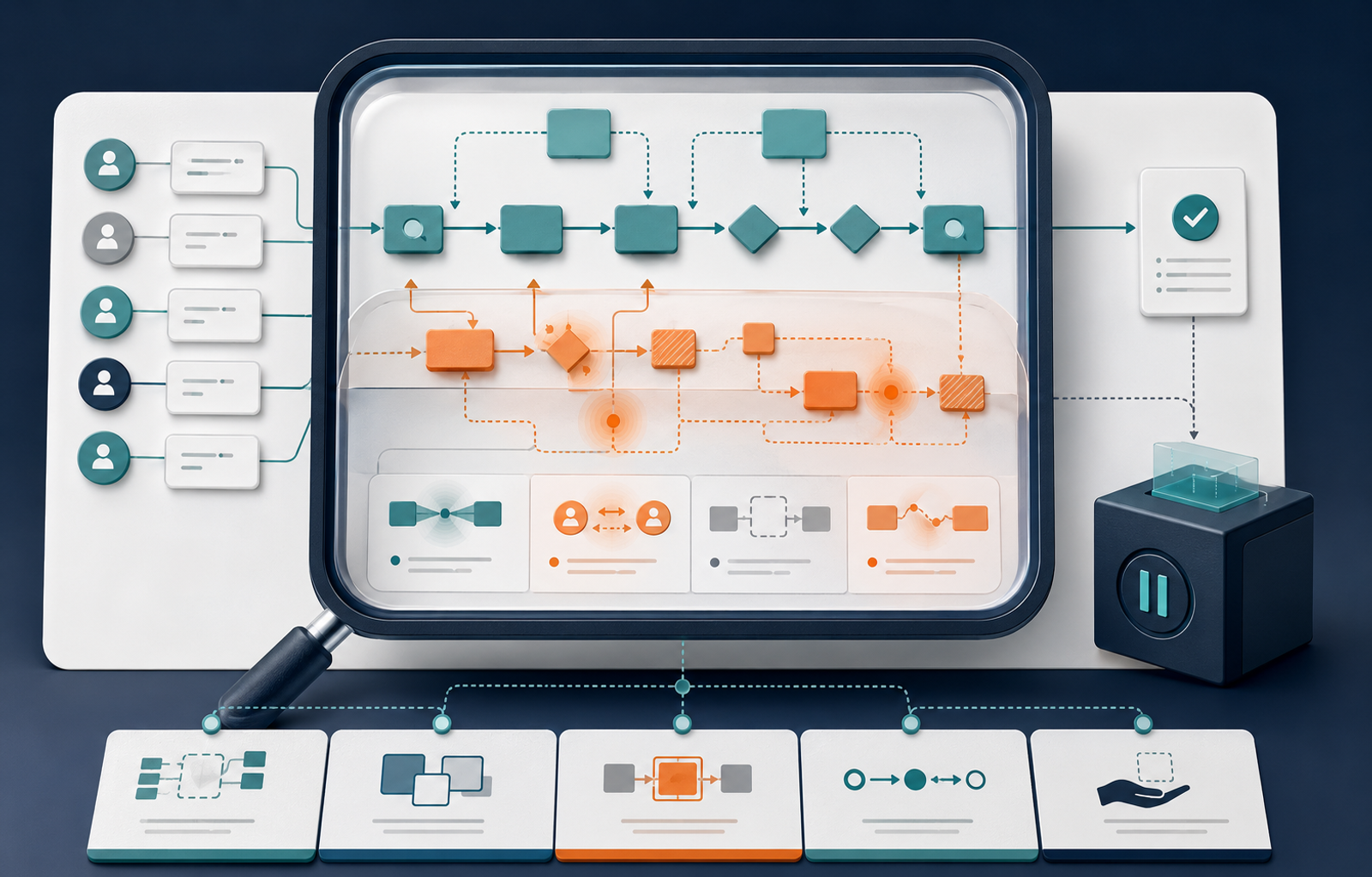
A paid assessment should reduce uncertainty with concrete artifacts, not extend discovery indefinitely. The useful outputs normally include:
- a current-state workflow with actors, states, tools, and handoffs;
- pain points, bottlenecks, duplicated work, and visible exception paths;
- system and data-ownership boundaries;
- risk findings around fragile or downstream handoffs;
- a build, buy, integrate, simplify, or leave-manual recommendation;
- a phased next-step roadmap with explicit exclusions.
The result may justify workflow automation, CRM or integration work, a dashboard, AI-assisted support, an internal platform, or no build at all. A responsible assessment is allowed to conclude that the proposed software is not the right next step.
How this differs from a generic discovery call
A short intro call can confirm fit and clarify which path deserves attention. It should not be expected to recover the workflow, assign ownership, evaluate data risk, and produce a delivery roadmap for free.
Investigation is a bounded paid phase because the output changes the quality of every decision that follows. It protects the business from automating the wrong state, integrating the wrong source, or buying a tool that still leaves the core coordination problem unresolved.
Investigate when implementation would otherwise encode guesses
The threshold is not company size or tool count. It is whether uncertainty about ownership, state, data, exceptions, and consequences is material enough to make implementation risky.
If those signals match your current operation, start the Operational Systems Assessment intake with the workflow, pressure, and handoffs described as clearly as possible.